

Choosing the best court reporter entails more than just verifying availability. Certification requirements, expenses, and technology vary by market. Whether you need a court reporter Houston attorneys trust or experienced court reporters Bend law firms rely on, understanding the distinctions allows you to make an informed decision.
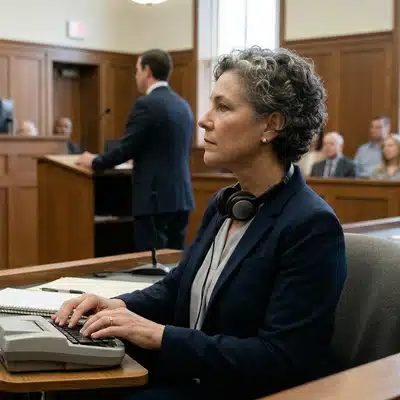
Every court reporter Houston firms hire must hold a Texas Certified Shorthand Reporter (CSR) license. Texas law prohibits anyone from practicing shorthand reporting without it. Candidates must pass a stenographic speed exam up to 225 words per minute, plus a written knowledge test. The Supreme Court of Texas oversees all CSR licenses through the Judicial Branch Certification Commission.
Always verify that your court reporter Houston attorneys plan to use holds an active CSR license before booking.
Oregon employs a distinct strategy. A notary public or any other authorized officer may administer the oath for depositions. Depositions do not always require a reporter who has been certified by the state. However, Oregon law mandates that reporters possess an Oregon CSR certification or a nationally recognized credential, such as the NCRA’s Registered Professional Reporter (RPR), for official court proceedings.
Reputable court reporters Bend law firms use will carry one of these credentials. Always ask, especially if the testimony may later appear in court.
Both Texas and Oregon face a serious nationwide court reporter shortage. Veteran stenographers are retiring faster than new ones enter the field.
According to a 2025 industry trends study by AAERT:
Houston is a major legal market with high demand. Even with a large pool of reporters, a qualified court reporter Houston legal teams depend on can book up fast. Schedule early, especially for multi-day depositions or trials.
There are fewer local reporters in Bend, which is a smaller market. You might have to use remote deposition technology or bring someone from Portland. As stated by U.S. According to Legal Support’s 2026 Litigation Trends report, 44% of litigation experts anticipate a rise in remote depositions. Even a Bend proceeding can be covered remotely by a Houston-based court reporter, which can reduce travel expenses and fill in scheduling gaps.
Costs are structured similarly in both markets, but key differences exist.
Most reporters impose a minimum appearance fee, which normally ranges between two and four hours, regardless of the length of the deposition.
Both markets offer optional services at extra cost:
Always request an itemized quote before the proceeding.

A transcript captures words. Video captures everything else. Tone, pauses, facial expressions, and body language all shape how jurors evaluate testimony.
Research by cognitive scientist Richard Mayer confirms that people retain information more effectively when words are paired with visuals. The Expert Institute notes that jurors respond better to seeing a witness on video than hearing testimony read aloud from a transcript.
That is why law firm video services have become a standard part of serious litigation strategy.
Houston-based litigation support firms typically offer a full suite of law firm video services, including:
Many Houston providers also offer specialized video production for attorneys, such as:
Bend has fewer dedicated litigation support firms. Core technology is available, including videoconferencing for remote depositions and electronic transcript delivery. You may need to coordinate a court reporter with an independent videographer. Plan ahead to secure both professionals for the same date.
The quality of video production for attorneys is achievable in Bend. It just requires more advance planning than in a larger city.
| Category | Houston, Texas | Bend, Oregon |
| Certification | Reporters must hold an active Texas CSR license. | Depositions may be handled by a notary or authorized officer, but court proceedings need Oregon CSR or a national credential like RPR. |
| Deposition Requirements | Licensed shorthand reporters are required for reporting services. | State-certified reporters are not always required for depositions. |
| Availability | Large legal market with more reporters, but demand is high and early booking is still important. | Smaller market with fewer local reporters, so scheduling can be harder. |
| Cost Structure | Local travel costs are usually low. Transcript rates vary by provider. | Travel costs may be higher if the reporter comes from Portland or outside Bend. |
| Expedited and Add-On Services | Real-time, video, rough drafts, and exhibit support are widely available. | Similar add-ons are available, but options may be more limited. |
| Video and Trial Technology | Strong access to full litigation support, including synced video, trial tech, and attorney video services. | Core remote and video tools are available, but firms may need separate vendors and more planning. |
Ready to book a court reporter or discuss law firm video services? Contact our team today to get a quote or schedule your deposition.
Yes. Texas requires all court reporters to hold a Texas CSR license. Texas generally requires court reporting services to be performed by a licensed Certified Shorthand Reporter (CSR). However, the specific requirements can vary depending on the nature of the proceeding, the method of recording, and any agreements or stipulations between the parties.
For depositions, Oregon allows notaries to administer oaths, so strict certification is not always required. For official court proceedings, Oregon law requires reporters to hold an Oregon CSR or a nationally recognized credential like the RPR.
A nationwide shortage is driving the problem. AAERT’s 2025 study found 76% of legal professionals struggled to schedule proceedings. Reporters are retiring faster than new ones enter the field. Book as early as possible, especially for multi-day cases.
Full-service providers, particularly in Houston, offer deposition video recording, real-time transcript feeds, trial presentation technology, and specialized video production for attorneys. These include day-in-the-life videos, accident reconstructions, and settlement documentaries.
Yes. The acceptance of remote deposits is growing. Through secure videoconferencing, a court reporter employed by Houston firms can report on testimony in real time, administer the oath, and attend a hearing. The admissibility of a deposition in Oregon does not depend solely on the deponent’s residency. It is determined by compliance with applicable procedural rules, including proper notice, administration of the oath, recording method, and any stipulations or court requirements.
For key witnesses and complex cases, yes. Video captures body language, tone, and credibility that a transcript cannot. Jurors engage more deeply with video evidence. It can also strengthen your position in settlement negotiations.
Choosing between a court reporter Houston teams trust and court reporters Bend law firms use is about more than location. It comes down to credentials, availability, technology, and the strength of the support behind the record. Central Texas Litigation Support Services brings more than 30 years of experience to that work, with a company history built around precision, ethics, and client satisfaction. Headquartered in Waco and serving firms locally and nationwide, the team combines certified reporting, legal video, and modern litigation technology to help law firms manage proceedings with confidence from scheduling through final delivery.
When the record is important, collaborate with a team that understands how to assist complicated litigation from start to finish. Central Texas Litigation Support Services provides consistent court reporting, experienced certified professionals, and litigation support designed to keep your case going efficiently, accurately, and without unnecessary delays.