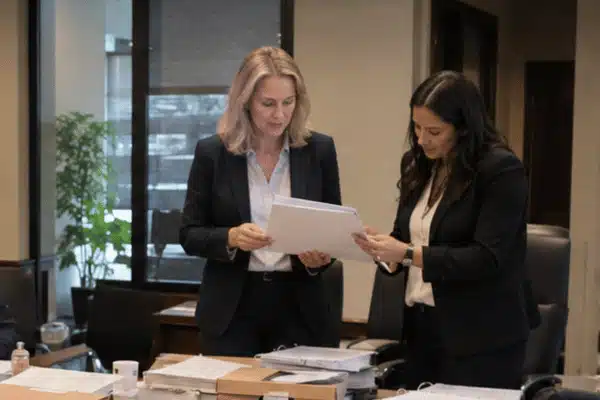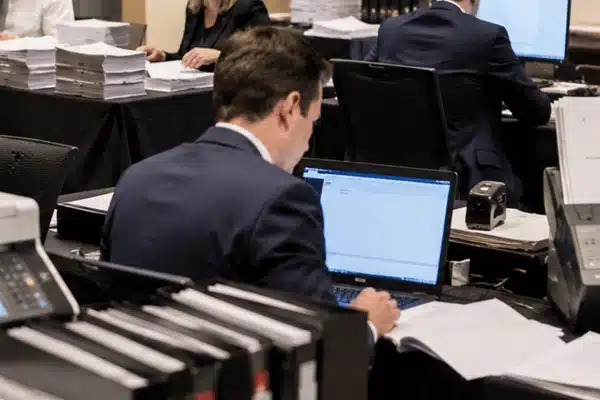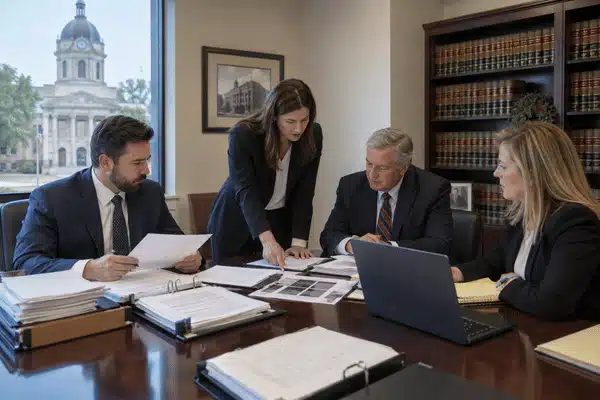

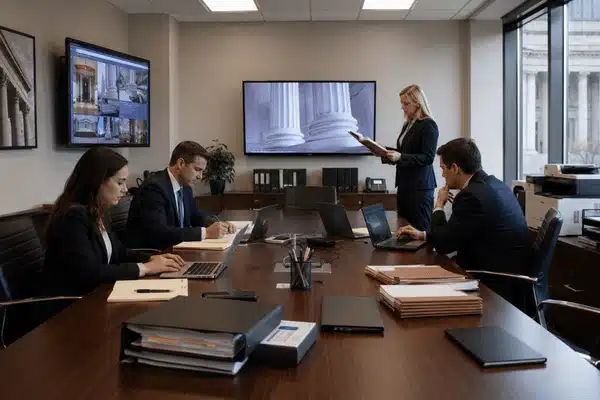
A trial war room isn’t just a conference room with a printer. It serves as your team’s command center. When everything works smoothly, attorneys may devote more attention to strategy rather than logistics. When it doesn’t, little issues escalate at the worst possible time. This article addresses the requirements for a suitable trial war room setup in 2026, including location, technology, security, staffing, and logistics.
Speed and proximity matter in a trial. Your team needs to respond to rulings, file exhibits, and prep witnesses without wasting hours on logistics. A well-run trial war room keeps everything and everyone in sync.
Here is what a strong war room setup protects against:
According to Thomson Reuters’ 2025 Future of Professionals Report, surveyed professionals estimated that AI could save about five hours per week, or nearly 240 hours per year. But AI only delivers that value inside a structured, secure trial environment.
The first decision is on location. Courthouse proximity reduces commuting time and keeps your personnel available during court breaks. Look for a location that is close by or in a neighboring hotel.
Tasks are divided into zones in a smart prep battle room. Noise and confusion are created by the combination of exhibit construction and witness preparation.
Lead counsel, second chair, and daily trial debriefs in the strategy room
Observe the peaceful, secluded preparation room away from paperwork.
Production area: Coordination of runners, printers, scanners, and exhibit staging
Overflow space: Assistance from IT, logistics, and remote co-counsel
A hybrid configuration can be a viable option in a variety of situations. Cloud-based solutions are used for collaboration and case analysis.
Create your exhibit workflow before trial week, not during it.
Cybersecurity is a must in a trial war room. In the Verizon 2026 Data Breach Investigations Report, vulnerability exploitation was the initial vector in 31% of breaches, and a third party was involved in 48%.
Your war room technician must be proficient in four areas: collaboration, case analysis, evidence management, and courtroom presentation. The ABA’s 2024 legal technology survey found that 73% of businesses use cloud-based legal tools, and 85% of litigators are using electronic court filings. Digital workflows are no longer an upgrade; they are the new baseline.
A hybrid configuration can be a viable option in a variety of situations. Cloud-based solutions are used for collaboration and case analysis. Backups and local hardware provide redundancy. Private servers may be ideal for situations requiring strong data segregation or customer confidentiality.
Create your exhibit workflow before trial week, not during it. The main war room technological layers are:
Court readiness tip: The Northern District of California gives courtroom technology recommendations, such as text-searchable PDFs where possible, logical file names, and counsel examination of electronic evidence prior to jury presentation. Check your local standing orders ahead of trial week.
Cybersecurity is a must in a trial war room. In the Verizon 2026 Data Breach Investigations Report, vulnerability exploitation was the initial vector in 31% of breaches, and a third party was involved in 48%. Verizon also said its use of banned “shadow AI” techniques by employees grew to 45%.
ABA Model Rule 1.1, Comment 8, instructs lawyers to stay current on the benefits and risks of the relevant technology, and Rule 1.6 requires reasonable efforts to prevent unauthorized access to client information. Your checklist should include:
When selecting software vendors, inquire directly whether your data is utilized to train AI models. In 2026, this should be viewed as a basic vendor due diligence question, particularly for legal teams managing confidential matter files.
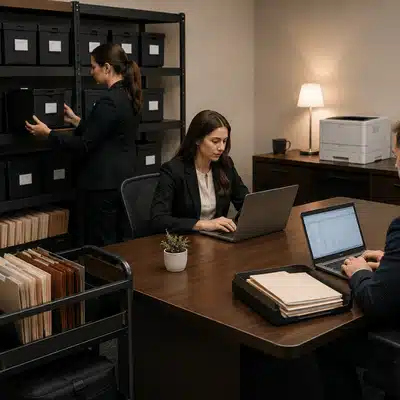
Your trial war room setup only works if the right people are in the right roles. Every modern trial team needs:
Consider huge displays, spare cables, a scan station, exhibit stickers, and a backup printer when planning your logistics. Prior to your team’s arrival, confirm building access hours, hotel internet quality, and delivery windows.
Start your trial war room planning at least eight weeks out.
| Timeline | Action |
| 8 Weeks Out | Confirm trial setting; reserve war room and hotel blocks; assign project advisor |
| 6 Weeks Out | Finalize room layout and staffing; confirm collaboration platform and permissions |
| 4 Weeks Out | Lock evidence workflow; validate exhibit repositories; start court format testing |
| 2 Weeks Out | Load core exhibits; verify naming conventions and searchable PDFs; test hybrid meeting stack |
| 1 Week Out | Install room hardware; run full failover drill; confirm runners, printing, and catering |
| Trial Week | Morning sync; court break response loop; end-of-day backup, reconcile, and next-day prep |
Ready to set up your trial war room? Contact Centex Litigation Support today to get a quote. Our trial support advisors will help you plan your war room setup from day one.
A trial war room is a designated area where a litigation team works during active trial preparation and the trial itself. It houses technology, exhibitions, printers, and workspace. A solid war room setup allows attorneys to focus on strategy while support staff handles logistics, papers, and court filings. It serves as both a secure information hub and a rapid reaction operations center.
Begin at least 8 weeks before the trial date. This provides you time to rent a courthouse-adjacent facility, obtain equipment, configure your collaboration platform, and test your evidence operations. Waiting until the last two weeks forces shortcuts that increase danger. Early preparation also enables venue-specific court technology testing, which many judges require.
Secure collaboration, case analysis, evidence management, and live courtroom presentation should all be part of your core war room technology stack. Large displays, a multipurpose printer, and a backup computer are examples of local hardware that you also need. Prior to trial week, test at least one offline or unchangeable recovery path. Although cloud technologies are commonplace, local redundancy is still important.
Encrypt all devices and removable media, use named accounts with MFA, and ask each software provider if they utilize your data to train AI models. Every time you handle evidence, keep a chain-of-custody log. ABA Model Rules 1.1 and 1.6 hold lawyers accountable for data security and technological proficiency.
Yes, but only if it is well governed. Document review, transcript analysis, and case organization can all be accelerated by approved AI techniques. Shadow AI, or unauthorized tools that employees use without screening, is a concern. According to Verizon’s 2026 DBIR, the adoption of shadow AI increased from 15% to 45% in a single year. Qualified legal professionals should authorize, scope, and supervise any AI tool used on matter files.
The cost varies depending on the magnitude of the matter and its duration. A lean setup for four to eight people on a short bench trial typically costs between $8,000 and $20,000. A normal hybrid war room for 8 to 20 members during a multi-week trial costs $20,000 to $60,000. Complex issues involving 20 or more users can cost $60,000 to $150,000 or more. Working with a local trial support partner near the courthouse can typically save money compared to national vendors.
For complex matters, a trial war room can help keep people, evidence, technology, and logistics organized when timing matters most. Central Texas Litigation Support Services supports legal teams in the Waco and Marshall areas with customized trial support, project advisors, office equipment rentals, logistics, IT services, and trial exhibits/legal graphics. With the right local support, your team can spend less time managing preventable problems and more time preparing for court.
Ready to build a trial war room before trial week pressure hits? Request a quote from Central Texas Litigation Support Services for local support with war room planning, equipment rentals, IT coordination, trial exhibits, legal graphics, and trial-week logistics in the Waco and Marshall areas.