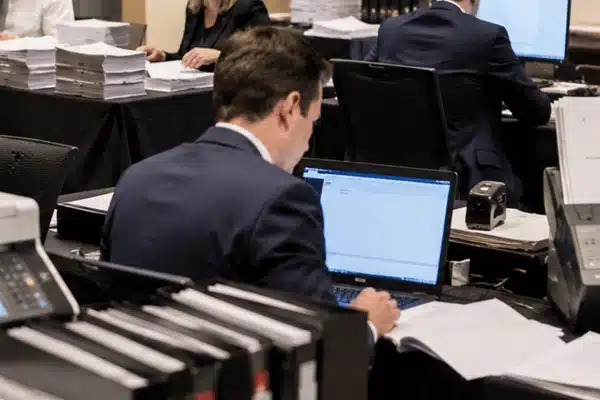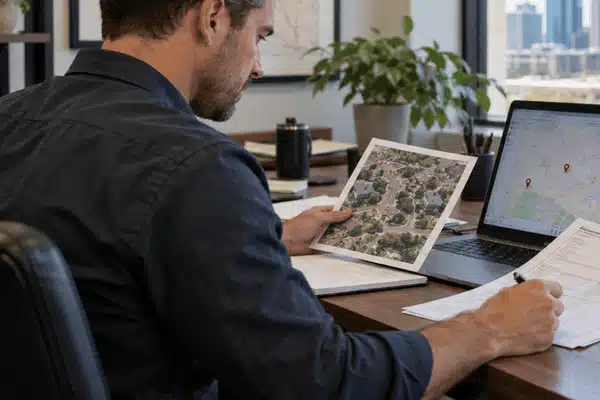

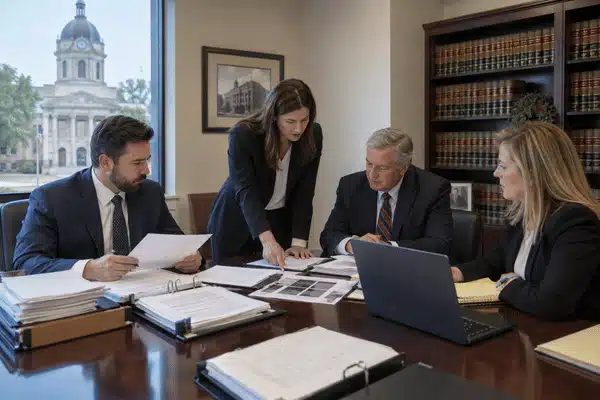
A Marshall trial can involve a lot of moving parts, especially when your legal team is coming from another city or state. Trial logistics in Marshall, TX, covers far more than travel plans. Court rules, attorney access, exhibits, courtroom technology, workspace, and local support all need attention before the trial begins.
Out-of-town teams also need to plan for the work that happens after court. That may include witness meetings, exhibit updates, printing, document review, and preparing for the next day. Sorting out those details early can prevent avoidable problems during trial week.
Trial logistics is the behind-the-scenes work that keeps a trial team organized. For firms traveling to Marshall, the list usually includes both courtroom needs and the work that happens back at the hotel or war room.
You may need to plan for:
Some legal teams handle all of this on their own. Others arrange out-of-town trial support, Marshall services for equipment, exhibits, IT, and local help during trial.
Centex Litigation works with trial teams in Marshall and provides project support, equipment rentals, logistics, IT help, and trial exhibits.
Before making travel or equipment plans, make sure you know which court will hear the case.
Federal matters in Marshall may be heard at the Sam B. Hall Jr. Federal Building and U.S. Courthouse, located at 100 East Houston Street. The Harrison County 71st District Court is at 200 West Houston Street.
For federal cases, the assigned judge matters too. Under the general orders effective September 1, 2026, Marshall civil cases are assigned 90% to Judge Rodney Gilstrap and 10% to Judge Robert W. Schroeder III, with Judge Gilstrap taking 100% of the division’s criminal docket.
Under General Order 26-07, Magistrate Judge Roy Payne receives 100% of the specified Marshall Division magistrate matters. Judge K. Nicole Mitchell’s 50% allocation applies to the Lufkin Division.
Each judge may have orders that affect exhibits, hearings, filing deadlines, or the way the trial is run. The Eastern District of Texas posts current orders on its website. Review those orders and the case docket before the team travels.
| Planning Item | What to Check |
| Court | Whether the case is in federal or state court |
| Judge | Standing orders and case-specific instructions |
| Attorney access | Admission, pro hac vice status, and ECF access |
| Technology | Approved devices, connections, and presentation setup |
| Exhibits | Marking, format, delivery, and post-trial requirements |
| Workspace | Internet, printing, monitors, storage, and meeting space |
A trial preparation checklist is easier to manage when it is broken into smaller jobs. Start with the items that can cause delays if they are left until trial week.
Well before trial, check that your team has covered the following:
An attorney who is not admitted to the Eastern District may need to appear pro hac vice.
The application first goes to the court by email for review. After approval, the stamped application is filed through ECF. The Eastern District of Texas currently lists the pro hac vice fee at $100. Regular admission generally takes about five business days.
A laptop that works perfectly in the war room may still need special handling at the courthouse.
Marshall’s visitor guidance is blunt: photo ID is required to enter, and no cell phones, cameras, laptops, or gaming devices are allowed.
At the same time, the electronic courtrooms are set up to accept attorney laptops for evidence presentations.
Because of that, do not arrive expecting to carry equipment through security without checking first. Confirm the process for your case before trial.
Courtroom 106 has HDMI connections and other presentation tools. The Eastern District recommends setting up technology training at least 24 hours before trial. Bring the laptop, cables, and adapters your team plans to use so you can test the actual setup.
Exhibits need their own part of the checklist. Local Rule CV-79 and the assigned judge’s orders should be reviewed before the final sets are prepared.
Key steps include:
The Eastern District also has guidance for sensitive exhibits. Video, source code, and some confidential materials may need to be placed on separate, labeled USB drives.
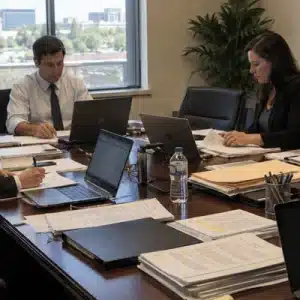
No. The court does not require a trial war room.
Still, it can make the trial week much easier for teams that have a lot of work to do after court. Think about what your lawyers, experts, and support staff will need each evening.
A longer case may involve late exhibit changes, witness meetings, document review, printing, or technical work. In those cases, working from a standard hotel room can become difficult very quickly.
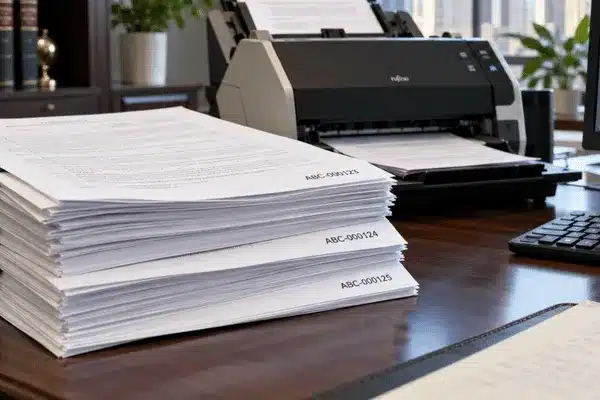
The court’s own rules shape the room more than most teams expect. Admitted exhibits may have to come back as PDFs with a signed index that matches the deputy’s list, which is evening work with a scanner and a second set of eyes.
Letter-sized copies have to exist before a hearing ends, which means printing capacity on-site. Public and sealed sets are docketed separately, which means someone has to keep them physically and digitally apart.
And because devices are restricted at the entrance and cables are not guaranteed in the courtroom, most teams keep a duplicate presentation kit in the war room rather than one kit that travels back and forth.
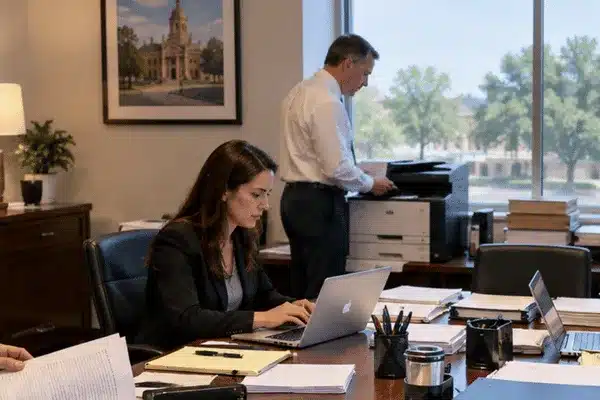
For trial logistics for law firms, a practical war room might have:
There is no standard war room that fits every case. A small trial team may only need a few basics. A larger team could need several workstations and much more space.
Two changes matter for the mechanics of a Marshall trial, and one matters for how the work gets done.
Exhibit retention got shorter. General Order 26-02, issued February 9, 2026, amended Local Rules CV-79(a)(4) and CR-55(c). Exhibits that are not docketed in the electronic filing system now need only be retained through final disposition of the case, and the offering party has 30 days after final disposition to retrieve them before the clerk may dispose of them.
The same order amended CV-4(a) to require plaintiffs to submit summonses electronically, with the pro se exemption in CV-5(a) carried across.
AI use is now another item for trial teams to think about.
According to the State Bar of Texas, AI use among surveyed Texas lawyers went from 30% in 2024 to 62% in the 2026 survey, released June 18, 2026. Among those using AI, legal research was the most common use, reported by 53%.
Federal teams working in Marshall also have court requirements to consider. Eastern District rules place responsibility on lawyers and litigants to check AI-assisted material before it is filed.
Eastern District of Texas rules make litigants and attorneys responsible for reviewing and verifying AI-assisted material before filing it. Some judges impose additional requirements.
For example, Judge Marcia Crone issued a July 2026 standing order requiring an AI-use certificate for filings in cases before her in the Beaumont Division. That order should not be presented as a general Marshall Division requirement. Trial teams should review the standing orders of the judge assigned to their case.
AI can help with research or drafting, but it does not replace review. Names, facts, case citations, confidential information, and filing rules still need to be checked by the legal team.
The Sam B. Hall Jr. Federal Building and U.S. Courthouse is at 100 East Houston Street, Marshall, TX 75670. It serves the Marshall Division of the Eastern District of Texas. Check your case notice for the correct courtroom before you travel.
Laptops are listed among devices prohibited under the courthouse’s general visitor rules. The courtrooms do support laptops for evidence presentations, though. Ask the court about the correct procedure before bringing one to trial.
That depends on the attorney’s admission status in the Eastern District of Texas. An attorney who is not admitted may need permission to appear pro hac vice. The current fee is $100 once the application has been approved.
The Eastern District recommends scheduling technology training at least 24 hours before trial. Test the same computer, cables, and adapters you expect to use in court. This is much safer than finding a connection problem when the jury is already waiting.
Not as a general practice. Local Rule CV-79 states that the parties keep their exhibits unless the court orders something different. Check the judge’s current orders as well, since a specific case may have added instructions.
No. A war room is a work choice, not a court rule. It makes sense when the team needs extra room for witnesses, exhibits, printing, document review, or evening preparation.
Good trial logistics remove small problems before they turn into trial-day distractions. Check the court rules early, test the equipment, prepare exhibits carefully, and make sure the team has a reliable place to work. If you need out-of-town trial support in Marshall, get a Quote from Centex Litigation for help with war rooms, equipment, IT, exhibits, and on-site trial logistics.