
Getting served with a lawsuit can be stressful. Some people refuse to answer the door or try to stay out of sight. But what happens if you avoid being served in Texas? In most cases, it only delays the process. The other side can ask the court for another legal way to serve the papers.
Texas courts have broad authority to approve a different method of service once the plaintiff can show a genuine effort and a credible address. The rules also start a clock. Under Texas Rule of Civil Procedure 99(b), the citation directs the defendant to file an answer by 10:00 a.m. on the Monday next after the expiration of twenty days after the date of service.
If no answer is filed by then, the plaintiff can ask for a default judgment under Rule 239. Once substituted service is completed in strict compliance with the court’s order, the defendant’s answer period generally runs from the date of that service.

Texas Rule of Civil Procedure 106 allows two common ways to serve lawsuit papers.
Rule 103 also controls who may serve the papers. This can include sheriffs, constables, certified process servers, and other people allowed by law or court order.
The rule lists three categories: any sheriff, constable, or other person authorized by law, any person authorized by law or by written order of the court who is not less than eighteen years of age, and any person certified by the Judicial Branch Certification Commission. There is one narrow carve out.
Unless a written court order says otherwise, only a sheriff or constable may serve a citation in a forcible entry and detainer action, a writ that requires the actual taking of possession of a person, property, or thing, or process that has to be physically enforced by the person delivering it.
A person who is part of the lawsuit cannot serve the papers themselves. Rule 103 puts it more broadly. No person who is a party to or interested in the outcome of a suit may serve any process in that suit, which rules out the plaintiff, the plaintiff’s business partner, and anyone with a stake in the result.
Serving others is only half the work. It must be demonstrated by the record. The return of service is governed by Rule 107, and Rule 107(h) stipulates that no default judgment may be granted until proof of service has been filed with the court clerk for ten days, excluding the filing and judgment days. Here, plaintiffs are subject to stringent compliance requirements from Texas courts.
For difficult cases, professional process service can help build a clear record of each attempt.
If someone keeps missing or avoiding a server, the case does not simply stop.
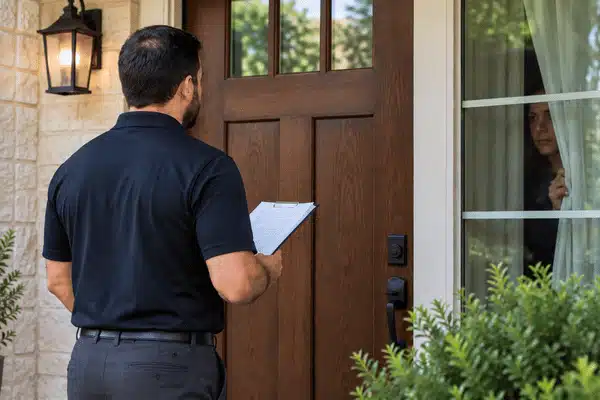
So, what happens if a process server can’t serve you? The server usually keeps records of each visit. This may include the date, time, address, vehicles seen, or other useful details. Those details are what a judge weighs later, so a log that reads “no answer” three times is far weaker than one that records a specific time, a lit window, a registered vehicle in the driveway, or a conversation with a neighbor.
Texas does not require a set number of attempts before another method can be requested.
What matters is whether the plaintiff can show a location where the defendant can probably be found.
That point came up in the 2026 case, Copa Room, LLC v. MM Mercer Boardwalk, LLC. The appeals court reversed a default judgment because the service record did not show a proper connection between the defendant and the addresses used.
A different result came in Vanicare Medspas, Inc. v. Limitless Medical Spa, LLC. There, several attempts were made at a home linked to the defendant. A neighbor also confirmed that he lived there.
The Beaumont Court of Appeals issued that opinion on June 19, 2025, in cause number 09-23-00237-CV. The process server documented five attempts at a Cypress residence with specific dates and times, and a neighbor confirmed that the individual defendant lived at the address, adding that she believed he was out of town. The court treated the neighbor’s statement as probative evidence supporting the affidavit.
It also rejected the argument that the plaintiff had to attempt service at a separate business address first, because Rule 106(b) asks for any location where the defendant can probably be found rather than every location where he might turn up. The default judgment, which awarded $120,847.55 plus prejudgment interest and $7,363.55 in attorney’s fees, was affirmed.
The difference was not just the number of visits. It was the quality of the proof.
A motion for substituted service asks the court to approve another way to deliver the lawsuit papers.
Under Rule 106(b), the supporting sworn statement should explain:
If the judge approves the request, the court may allow the papers to be left with someone older than 16 at that location.
The court can also approve another method that is likely to give the defendant notice.
The process server must follow the court’s order closely. Using a different method can create problems later, especially if the plaintiff asks for a default judgment.
The return of service should mirror the order, naming the method the court approved and describing exactly what was done, because that document is the proof the trial court and any appellate court will read.
Yes. Texas courts can allow service by email, social media, or another form of technology. The Texas Legislature directed the Supreme Court of Texas to adopt rules for service through a social media presence in Section 17.033 of the Civil Practice and Remedies Code, and the court added the current language of Rule 106(b)(2) by order in Misc. Docket No. 20-9103, effective December 31, 2020.
But the plaintiff cannot simply send a message and call it service. The court must approve the method first. The evidence also needs to show that the method is likely to reach the defendant.
In practice, that means showing the account or address belongs to the defendant and is in current use, rather than assuming a profile with a matching name is the right person.
Rule 106(b) requirements still apply. A valid email address by itself does not replace the need for proper sworn proof.

Is it illegal to avoid being served in Texas? Simply staying out of sight is not treated the same as interfering with a process server.
Texas Penal Code § 38.16 covers interference with civil process. It makes it an offense to knowingly or intentionally stop civil process through words or physical action.
That does not mean avoiding service makes the lawsuit disappear. It may only lead to more attempts or a request for another method of service.
In Proulx v. Wells, the Texas Supreme Court looked at evidence of avoidance along with repeated service efforts when deciding whether the plaintiff had acted with due diligence.
The plaintiff’s team made roughly thirty attempts at five addresses over about nine months, using two process servers and two investigators, and one investigator concluded that the defendant was moving from relative to relative to avoid service from creditors and courts.
The court asked whether the plaintiff acted as an ordinarily prudent person would have acted under the same or similar circumstances and stayed diligent until service was obtained, and it held that the defendant had not established a lack of diligence as a matter of law. Evasion, in other words, tends to help the plaintiff rather than the person hiding.
For legal teams, knowing how to serve someone who is avoiding service often comes down to careful records and a verified address.
Useful steps include:
Rule 109 may allow for citation by publication if the defendant is genuinely unlocatable. A sworn demonstration and evidence of due diligence are also necessary for that option.
Shamrock Enterprises, LLC v. Top Notch Movers, LLC, a 2026 Texas Supreme Court case, demonstrates the importance of service details. After discovering issues with statutory service through the Texas Secretary of State, the court revoked a default judgment.
The lawsuit can still move forward. The plaintiff may continue trying to serve the papers or ask the court for another approved method. Avoiding the server does not cancel the case.
There is no set number under Rule 106. Judges look at the facts behind the attempts. Several visits may not be enough if they were made at the wrong place.
Only when the court has approved a method that allows it. A server cannot normally leave papers at the door just because no one answered. The court order controls what happens next.
The plaintiff may ask for substituted service. If the defendant cannot be found after a proper search, publication may also be an option. The right method depends on the case and the court’s order.
Avoiding detection is not the same as blocking service through words or physical action. Texas law treats those situations differently. Avoiding service can still make it easier for the other side to seek another lawful method.
Yes. Personal hand delivery is not the only valid form of service. A default judgment may still be entered if another approved method was used correctly and the defendant did not respond.
Avoiding a process server may slow things down, but it usually does not stop the case. Good records, a verified location, and the right court order matter when service becomes difficult.
Need help with a hard-to-serve defendant? Get a quote from Central Texas Litigation Support Services for process service and skip tracing across Texas.