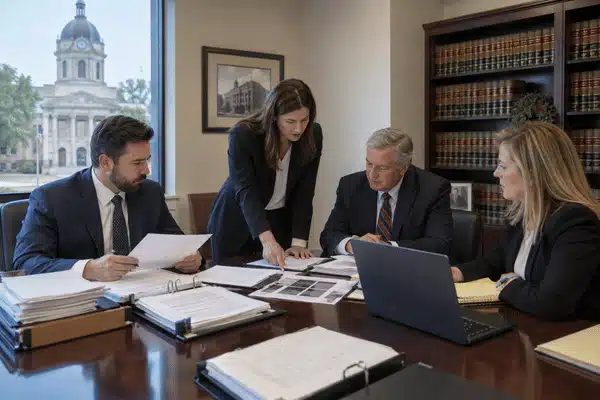

When the trial starts, there is rarely much spare time. A printer goes down. An exhibit changes. Someone needs a document before the next session. A trial war room, Marshall, TX team can use gives everyone a nearby place to deal with those needs without losing time traveling back to a hotel or office.
For larger cases, that room often becomes the working center of the trial team.
That matters more in Marshall than it would in a major metro. Marshall is a city of 23,392 people in Harrison County, roughly 40 miles west of Shreveport, Louisiana, at the point where Interstate 20 meets U.S. Route 59. A team flying in from Dallas, Chicago, or California is working in a small East Texas city rather than a legal services hub, so space, equipment, and support have to be arranged well before the first day of trial.
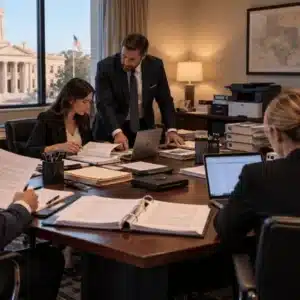
A trial war room is a private work area set aside for the legal team while a case is in court.
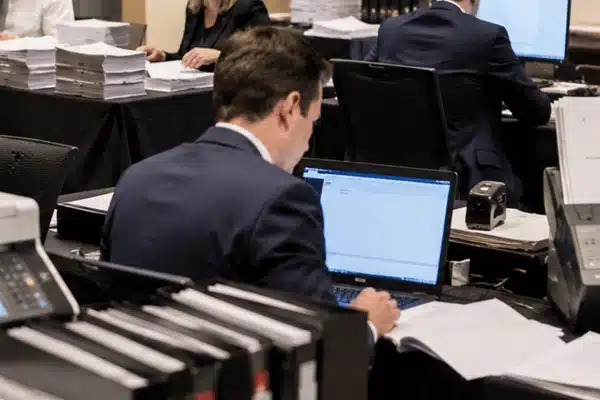
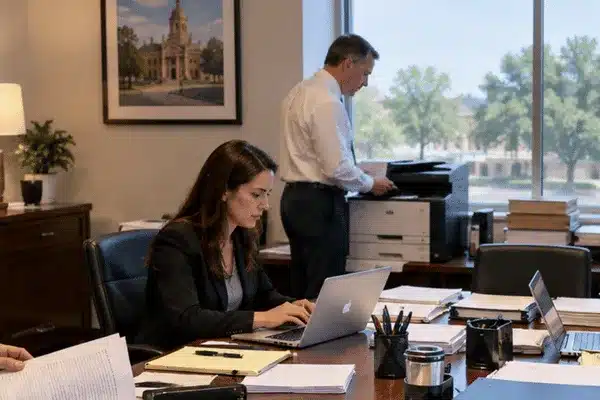
It is where attorneys and support staff can review testimony, prepare exhibits, make copies, talk through strategy, and handle work that comes up during the day.
The setup can be simple or fairly large.
A small team may only need a table, printer, secure internet, and a few monitors. A complex patent case may call for several workstations, exhibit space, IT help, couriers, and a separate area for witness prep.
The volume of material is easy to underestimate. Under Chief Judge Rodney Gilstrap’s amended standing order on the number and use of exhibits, signed on August 8, 2023, parties in a patent or FRAND case before him work from a joint exhibit list of no more than 75 exhibits, and each side may serve its own list of up to 30 additional exhibits. In other civil cases the limits are 60 joint exhibits and 25 additional exhibits per party. Only pre-admitted exhibits may be presented at trial, with a narrow allowance of up to four omitted documents on a showing of good cause. Every one of those documents still has to be organized, copied, tracked, and produced on demand, and the war room is where that work happens.
The point is not to fill a room with equipment. It is to give the team what it actually needs to work.
A war room near the Marshall courthouse can save a surprising amount of time.
Sam B. Hall Jr. The address of the United States Courthouse and Federal Building is 100 East Houston Street. Staff can complete a last-minute print job, update a demonstrative, or deliver a document to counsel without having to travel across town if the war room is nearby.
During a trial, that distance is more important than it might be during a typical workday.
Another reason to stay close is parking. Public street parking and a lot on Bowie Street are listed by the court, along with wheelchair ramp access and accessible parking at the intersection of Bowie and South Washington Streets. That should be resolved before the first morning, not during it, by a team that moves boxes, monitors, and exhibit boards multiple times a day.
The Eastern District of Texas also lists phones, laptops, cameras, and gaming devices among items restricted at courthouse entry. Marshall courtrooms do have presentation systems with HDMI connections for approved laptop use.
Because courthouse entry rules and courtroom tech rules are not the same thing, teams should check with court staff before trial.
The district also recommends scheduling courtroom technology training at least 24 hours before trial begins, arranged through the presiding judge’s chambers, and bringing the actual laptops and equipment to that session rather than a stand-in. Electronic evidence presentation systems are installed across seven divisions, including Marshall, so a team that has tried a case in Tyler or Sherman will find a familiar setup, but the training slot is still worth taking.
A nearby workroom gives the team another place to handle digital files, calls, printing, and case prep throughout the day.
A practical setup keeps the trial team organized, secure, and ready for last-minute needs.
A good trial war room setup starts with the case, not the equipment list.
Although it is not the only test, being close to the courthouse is helpful. Verify the team’s daily entry time and the availability of any after-hours access. Inquire about parking, delivery access, internet service and bandwidth, and whether a courier can get to the door. A team getting ready for the next morning shouldn’t be in a place that locks at six o’clock in the evening.
Find out if other tenants share the space, who else has the keys, and whether cleaning personnel come in unsupervised. Before sensitive information is left on a table for the entire nite, those inquiries seem insignificant.
Trial teams bring more into a room than laptops.
There may be exhibit boxes, binders, monitors, printers, chargers, food, and stacks of paper. Give people room to work without turning every table into storage.
Paper builds up more quickly than most teams anticipate in a patent case based on a joint exhibit list of up to 75 documents, plus additional exhibits, deposition designations, expert materials, and demonstratives from each side.
If space allows, keep one area open for witness prep or private talks.
Do a full equipment check before the first day.
Test the following:
A spare HDMI cable may sound minor until one disappears ten minutes before it is needed.
War rooms can hold case strategy, witness information, exhibits, and other private material.
Use a secure internet connection and encrypted storage. Keep the room locked when it is empty. Limit access to people working on the case.
This is a professional obligation as much as a practical one. ABA Model Rule 1.6(c) requires a lawyer to make reasonable efforts to prevent the inadvertent or unauthorized disclosure of, or unauthorized access to, information relating to the representation of a client. A temporary room in an unfamiliar building is exactly the setting where that duty is easiest to overlook.
Paper files need the same care as digital files.
During the trial, someone will need toner, a courier, a car, another monitor, or a late meal.
Choose one person who can handle those requests. That may be a trial coordinator, litigation support specialist, or project advisor.
Give that person the court contacts as well, including the clerk’s office number, so a question about filing or building access does not have to travel through an attorney in the middle of a session.
It keeps small problems from landing on the attorneys’ desks.
It’s also possible to avoid some of the most annoying trial issues.
Paper, toner, chargers, labels, folders, markers, extension cords, and basic office supplies should all be kept close at hand. Make travel and meal plans as well, particularly for lengthy court days.
There is no fixed war room package. What matters depends on the case.
| Need | Typical Setup |
| Work space | Desks, chairs, whiteboards |
| Tech | Monitors, printers, Wi-Fi, docking stations |
| Case files | Binders, copies, secure storage |
| Trial exhibits | Boards, charts, timelines, presentation files |
| Support | IT help, couriers, project support |
| Daily needs | Meals, supplies, local transportation |
Central Texas Litigation Support Services works with legal teams trying cases in Marshall and Waco. Support may include equipment, IT help, exhibits, couriers, transportation, office setup, and other trial needs.
The Eastern District of Texas remains an important venue for patent disputes.
Unified Patents reported that the Eastern and Western Districts of Texas received about 37% of U.S. district court patent filings in the first half of 2026. The Eastern District alone received 46.6% of NPE patent filings during that period.
Trial support has also become more tied to online tools.
The American Bar Association reported that 73% of law firms used cloud-based legal tools in its 2024 Legal Technology Survey. It also found that 60% had formal cybersecurity policies, that 85% of litigators use electronic court filing, and that 67% of attorneys rely on fee-based online research services. The cybersecurity figure cuts both ways: two firms in five still had no formal policy in place.
For an Eastern District of Texas war room, that changes what teams need on site.
A printer still matters. So do secure file access, steady internet, video calls, shared documents, and digital exhibits. Remote experts and co-counsel may also need access during the day.
It is a private work area for the legal team during trial. Teams use it for exhibits, meetings, printing, witness prep, and case review. In a longer case, it can serve as the team’s temporary office.
Once the trial dates are reliable enough for planning, begin. The team has more options for equipment and space when they book early. Everyone has time to test the setup as well.
Yes. Teams often use their own devices in the war room. Courthouse rules are different, so confirm what can be brought into the building before trial.
No. A short case with a small team may need very little space. A full war room makes more sense when the case involves several attorneys, experts, exhibits, or trial days.
Keep the room locked when no one is there. Use secure internet, strong passwords, and encrypted storage. Access to case files should stay limited to the trial team.
Yes. Video calls and shared files can bring remote experts or co-counsel into the day’s work. Test the connection and file access before the trial begins.
The best war room is not the one with the most equipment. It is the one that helps the team get through the day without wasting time on avoidable problems. Central Texas Litigation Support Services can assist with war room setup, IT, equipment, exhibits, couriers, and local trial logistics in Marshall. Get a Quote to discuss what your team will need.