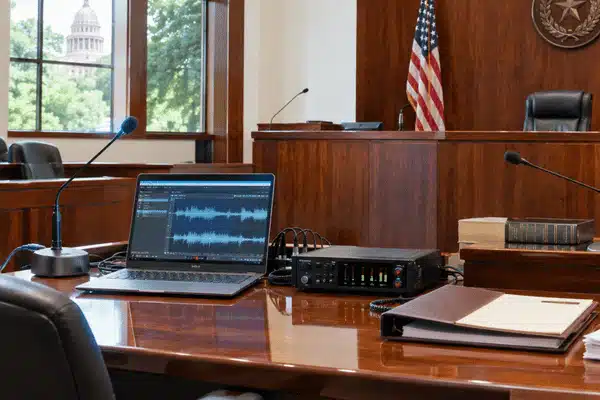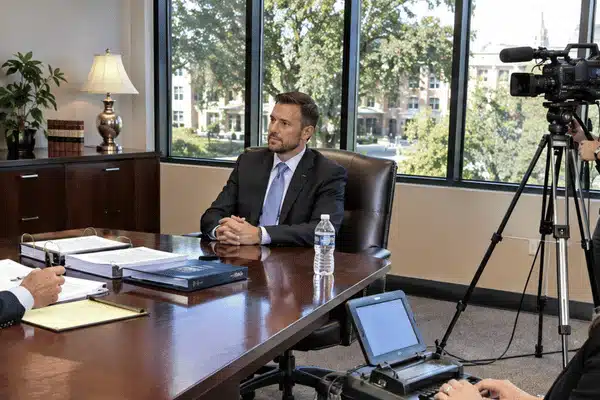
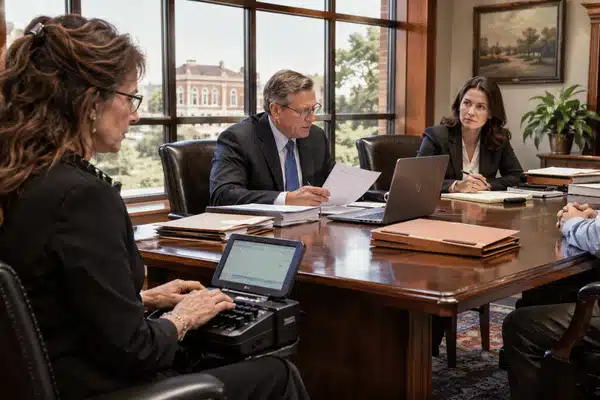
Heading to Marshall for a deposition or trial? If you’ve searched for court reporting Marshall TX, there’s more to consider than finding an available reporter. Texas has its own certification rules, and federal cases follow a different set of procedures.
If your case is in Harrison County, you’ll need to follow Texas rules for depositions and court reporters. Federal cases work differently. They follow federal procedures along with the Eastern District of Texas’s local rules. Even things like recording testimony and reviewing transcripts may have different requirements. It’s worth checking these details before you book anything, especially if you’re travelling from another state.
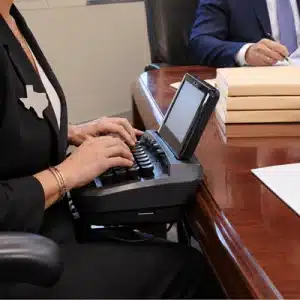
Texas has rules about who can record testimony during a deposition. Under Texas Government Code §154.101, depositions held in the state generally require a Certified Shorthand Reporter (CSR). There are exceptions, though, including certain cases where a certified reporter isn’t available.
If a certified shorthand reporter is unavailable, Texas Government Code §154.112 provides two ways to proceed with an uncertified reporter. The reporter can give the parties or their counsel an affidavit stating that a certified shorthand reporter is unavailable. The reporter must deliver it before the deposition begins and file it with the court as part of the certification required by Texas Rule of Civil Procedure 203.2. Alternatively, the parties or their counsel can stipulate on the record at the start of the deposition that a certified shorthand reporter is unavailable. Texas Civil Practice and Remedies Code §20.001 covers who may take depositions on written questions.
The rules also depend on where your case is filed.
The Judicial Branch Certification Commission (JBCC) oversees court reporter certification in Texas. A CSR certification is valid for two years, and renewal requires 10 hours of continuing education, including 2.5 hours in ethics or Texas rules.
If you’re coming from another state, don’t assume your usual reporting arrangements will work here. Check the rules before setting the date.
Marshall is in Harrison County and falls within the Eastern District of Texas (EDTX). The Marshall Division covers Camp, Cass, Harrison, Marion, Morris, and Upshur counties. The court handling your case determines which rules apply.
Planning a deposition for a Texas state case? Start by checking whether your reporter holds a current CSR credential. You’ll find reporters working directly for the courts, while others take on depositions for law firms.
A license from another state won’t necessarily qualify someone to work in Texas. Check their credentials before you confirm the booking, especially if an exception might apply.
A court reporter Eastern District of Texas attorneys hire must meet federal requirements.
Under Federal Rule 28, depositions may be taken before someone authorized to administer oaths or appointed by the court. Rule 28(a) refers to an officer authorized to administer oaths under federal law or under the law of the place of examination. For a deposition taken in Marshall, the place of examination is Texas. Rule 28© also disqualifies anyone who is a party’s relative, employee, or attorney, anyone related to or employed by a party’s attorney, and anyone with a financial interest in the case.
The Eastern District’s Local Rule CV-30 adds rules of its own. Depositions may be taken after 5:00 p.m., on weekends, or on holidays only with a judge’s approval or by agreement of counsel. Objections to questions are limited to “Objection, leading” and “Objection, form,” and objections to testimony are limited to “Objection, nonresponsive.” A party may not instruct a deponent not to answer unless Federal Rule 30©(2) permits it. For a neutral nonparty witness, or a witness all parties must examine, the time limit is divided equally between plaintiffs and defendants.
If you’re handling a federal case, check the relevant rules and your judge’s orders. This matters when you’re bringing a reporting team from outside Texas.
Yes. You don’t always need everyone in the same room to take testimony.
Texas Rule 199.1(b) permits remote oral depositions under its notice requirements. For federal cases, Rule 30(b)(4) allows remote depositions by agreement or court order. Both rules tie a remote deposition to the witness’s location. Under Texas Rule 199.1(b), it is considered taken in the district and at the place where the witness is located. Under Federal Rule 30(b)(4), it takes place where the deponent answers the questions.
Texas Government Code §154.105 also permits CSRs to administer oaths remotely. The witness’s identity must be checked using an approved method.
Before the deposition, ask your reporting provider:
Which video platform will be used?
How will the witness be verified?
Who will manage and mark them?
Audio, video, or stenographic?
What’s the plan if someone disconnects?
These details are easy to overlook when counsel and witnesses are joining from different locations.
With real-time court reporting East Texas, attorneys can follow testimony as the witness speaks. The reporter’s live text feed appears on a laptop or other device.
This can be useful during patent depositions, especially when witnesses discuss technical terms or detailed processes. Counsel can review answers without waiting for the finished transcript.
Ask about real-time availability and any extra costs when scheduling.
Marshall has both federal and state courts. Make sure you have the right address before leaving your hotel.
| Court | Address |
| U.S. District Court, Marshall Division | Sam B. Hall Jr. Federal Building, 100 E. Houston St., Room 125 |
| 71st District Court, Harrison County | Harrison County Courthouse, 200 W. Houston St., Suite 219 |
If your hearing is in federal court, you’ll likely be heading to the Sam B. Hall Jr. Federal Building. District Judge Rodney Gilstrap and Magistrate Judge Roy Payne serve in the Marshall Division. Check your hearing notice for the assigned judge and courtroom.
The federal Clerk’s Office is open Monday through Friday, 8:00 a.m. to 5:00 p.m., except federal holidays. Public street parking is available, along with a parking lot on Bowie Street. Accessible parking and a wheelchair ramp are at the corner of Bowie and South Washington Streets.
For state cases, Judge Brad Morin presides over the 71st District Court in the Harrison County Courthouse.
Booking deposition services Marshall Texas counsel need is easier when the reporting agency has the full case details.
Start with the date, location, and expected length of the deposition. Then explain how you plan to record the testimony.
Before contacting the reporting agency, gather the information they’ll need. You don’t have to know every detail yet, but having the basics ready makes booking easier.
For a court reporter for patent litigation EDTX cases may need, ask about experience with technical testimony. Patent witnesses often use terms that require careful preparation.
Centex Litigation’s court reporting services include real-time reporting, remote deposition support, and legal video services. Contact the team to discuss availability for your Marshall case.
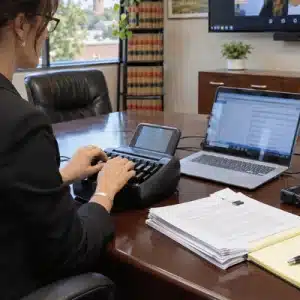
Court reporting isn’t limited to a reporter sitting beside a witness with a stenography machine. Attorneys now have more ways to handle testimony, exhibits, and transcripts.
Remote depositions are an established option. Counsel can question witnesses from different locations, provided the session follows the applicable rules.
There’s another thing to watch. The Eastern District of Texas updated Local Rule CV-11(g), effective December 1, 2025. If AI is used to help prepare a court filing, the person submitting it must check the content for mistakes. That applies to attorneys and other litigants, not just people representing themselves.
Court rules don’t stay the same forever. Texas made another change on October 2, 2026, when the Supreme Court approved amendments to Rules 47 and 169 of the Texas Rules of Civil Procedure.
The changes raised the expedited actions limit from $250,000 to $325,000. Cases under this process follow Level 1 discovery rules in Rule 190.2. That includes a limit of 20 hours in total for each party to examine and cross-examine witnesses during oral depositions. If you’re handling one of these cases, keep that limit in mind when planning your schedule.
The Eastern District of Texas also shared proposed changes to its local rules in November. It’s worth checking for updates before you head to court.
Bringing a reporter from another state? Check their credentials first. A licence from another state doesn’t automatically qualify someone to report depositions in Texas. Most Texas state depositions require a CSR, although certain exceptions apply. Federal cases have different requirements under Rule 28, so check which rules cover your case.
A CSR is a reporter certified by the Supreme Court of Texas. The JBCC oversees certification and related rules. You can check a reporter’s current credentials before hiring them.
Yes. Texas Government Code §154.105 allows CSRs to administer oaths remotely. The reporter must follow the required identity checks. Ask how this will work before the deposition starts.
As soon as the date is set, reach out to a reporter. You may also need video or a live transcript feed, and those take planning. If the date is close, ask what’s available and whether rush fees apply.
Bring your photo ID and the documents you need for court. If you want to take a device inside, bring your bar credentials and check the court’s policy first. You don’t want to learn at the entrance that your laptop can’t come in.
Centex handles court reporting and related work for complex cases. Patent testimony can involve unfamiliar product names and technical terms, so ask about the reporter’s experience. Call the team to discuss coverage and timing for your Marshall deposition.
In federal court, Rule 30(b)(3)(A) generally allows video as the sole recording method, subject to any court order. The deposition notice must specify video, and a deposition officer is generally still required.
Texas state courts also allow video depositions under Rule 199.1©. If you’re planning to record one, there are a few things to arrange first.
The witness and other parties must receive at least five days’ notice that video recording will be used. The notice should explain how the deposition will be recorded and whether you’ll also have a stenographic record.
You’ll also need someone legally authorised to administer the oath. If you want a written transcript along with the video, discuss that with your reporting agency before the deposition. Texas Government Code §154.114 provides certain exemptions from court reporter certification requirements for parties, their attorneys, and their full-time employees.
Court reporting in Marshall takes a little planning, particularly when you’re travelling from another state. Confirm the reporter’s credentials, check your court’s procedures, and decide how testimony will be recorded. If you need help arranging an upcoming deposition, contact Centex Litigation to get a quote or book your court reporting services.