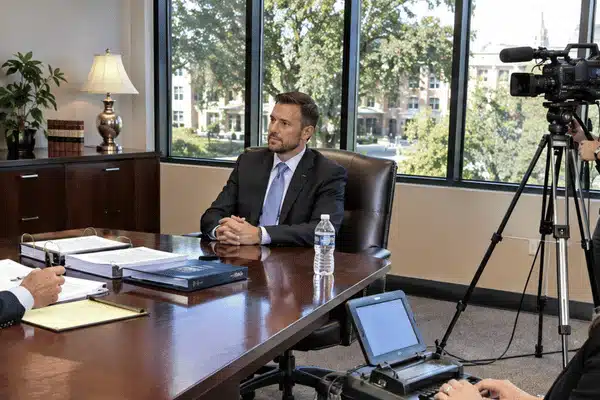

Texas courts are looking at digital court reporting as a way to deal with a shortage of certified reporters. Some courts already record hearings, but the legal rules still matter.
The Texas Office of Court Administration (OCA) took a closer look at this issue in a study released October 1, 2026. OCA contracted with the Public Policy Research Institute (PPRI) at Texas A&M University to carry out the research. The PPRI team worked from January to September 2026, using a national policy scan, a review of current use in Texas, stakeholder surveys and interviews, courtroom observations, and a cost analysis. One concern is what happens when a recording misses something important during testimony.
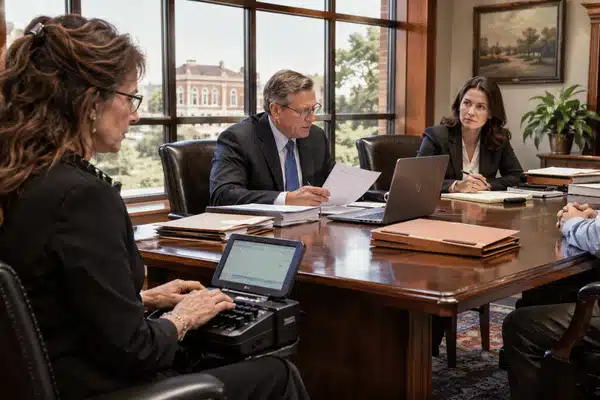
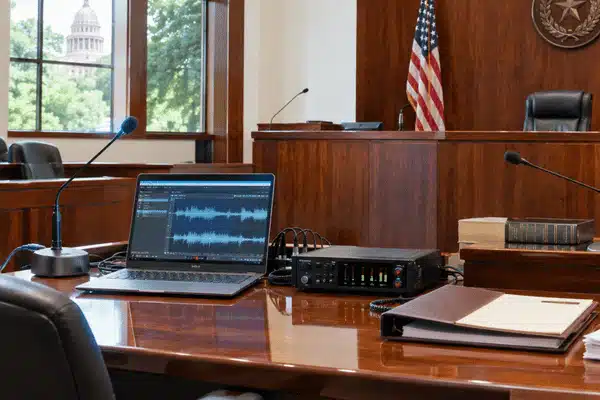
Digital court reporting uses recording equipment to capture what people say during a hearing or other legal proceeding. Texas lawmakers used a similar definition in Senate Bill 1538, the 2025 bill that first proposed the OCA study. It described digital court reporting as making a verbatim record of a court proceeding, deposition, or grand jury proceeding through digital technology, electronic recording equipment, or other recording and transcribing technology.
An operator monitors the sound. A transcript can be prepared from the audio later.
Good sound equipment is only part of the job. The person handling the recording also needs to:
These are useful precautions, not one set of statewide rules. Courts that already make the official record electronically do have some baseline duties to follow. Under Texas Rule of Appellate Procedure 13.2, the official court recorder must make sure the system works throughout the proceeding and produces a complete, clear, and transcribable recording. The recorder must also keep a detailed log showing who is speaking, each exhibit offered, and the time of each event, file that log with the clerk, and keep the original recording stored so no one can access it without a written court order.
The PPRI study recommended going further with minimum statewide standards for digital recording systems, including multichannel audio capture, real-time monitoring, time-stamped logs, redundant backups, and a defined retention period.
Finding an available court reporter has become harder for some Texas courts, particularly those outside major cities.
The Texas A&M University Public Policy Research Institute found that the number of active certified shorthand reporters (CSRs) fell by about 14% over 20 years. During that same period, the number of trial court benches grew by more than 14%.
More than half of Texas-based active CSRs (55.4%) were first certified before 2000. Nationally, the average age of working stenographic reporters is 55, according to National Court Reporters Association data cited in the study.
The training pipeline is small, too. The study counted six court reporting schools recognized by the state’s Judicial Branch Certification Commission, and it found that the number of court reporter training programs nationwide fell 27% between 2022 and 2026.
Digital recording is one option for courts struggling to fill hearing schedules.
According to a September 2026 Texas Judicial Council memorandum, some counties already have orders allowing electronic recording. Of Texas’ 254 counties, 42 have formal administrative orders authorizing it. Examples include local rules the Supreme Court of Texas approved for courts in Angelina, Brazos, and Cherokee counties, which assign court recorders to keep the recording system working and maintain a detailed log of each proceeding.
| Type of Proceeding | Counties With Authorizing Orders |
| Civil matters | 42 |
| Criminal matters | 21 |
These figures do not mean every courtroom in those counties uses digital recording. Courts must follow the orders and rules that apply to their proceedings.
The digital court reporter vs stenographer difference starts with how testimony is captured.
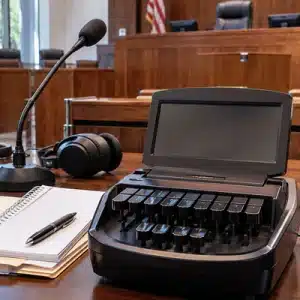
A certified shorthand reporter uses an approved shorthand method to record testimony. This may involve a stenotype machine or voice writing. Texas Government Code Section 154.101 lists the authorized methods as written shorthand, machine shorthand, oral stenography, or any other method the Supreme Court of Texas authorizes.
To earn a Texas CSR credential, candidates must pass a skills test and a written test. Under Government Code Section 154.103, the skills test has three five-minute sections: questions and answers between two speakers at 225 words per minute, jury instructions at 200, and a literary passage at 180. Candidates need at least 95% accuracy in each section.
| Certified Shorthand Reporter | Digital Recording Operator |
| Uses approved shorthand methods | Uses electronic recording equipment |
| Creates a shorthand record of testimony | Monitors and preserves audio files |
| Prepares and certifies transcripts | Transcript prepared separately under applicable rules |
| Holds Texas CSR certification | Proposed registration would involve separate training |
Operating recording equipment does not make someone a Texas-licensed CSR. The PPRI study noted that Texas statute does not define what makes a record accurate. Stakeholders pointed to the 95% verbatim threshold from the CSR exam as the working benchmark, and no comparable standard or certification exists for digital recording.
The OCA study, Capturing the Record, examined costs and risks. In September 2026, the Texas Judicial Council considered several changes.
The Council wants the Judicial Branch Certification Commission (JBCC) to oversee a new registration process for digital recording operators.
Under the proposal, operators would learn how to use the equipment, follow courtroom rules, and keep recordings secure.
The Council also called for a trained person to watch over each proceeding rather than leave the equipment running unattended.
Specifically, it asked the Supreme Court of Texas to consider requiring a registered court recorder assigned exclusively to each proceeding that uses digital recording. The Council’s memo found that states universally require human monitoring wherever digital recording is authorized, and that centralized monitoring of several courtrooms does not adequately protect the accuracy of the record.
Another idea is to provide grant funding for courts that want to try digital recording.
Those courts could report what the equipment costs, how it performs during hearings, and what problems arise.
The Council also wants to make it easier for qualified people to become Texas CSRs. One suggestion is to accept certain national skills test scores as part of the certification process.
It also called for courts to publish their transcript fees. That would help attorneys know what to expect before ordering a transcript.
For now, these remain recommendations. Texas has not adopted them as new statewide rules.
Under Texas Government Code Section 154.101(f), depositions taken in Texas generally require a certified shorthand reporter.
Section 154.112 allows an exception when no CSR is available, subject to stated conditions.
Texas Rule of Civil Procedure 199.1(c) also permits non-stenographic recording with proper notice and safeguards. That does not automatically remove the separate CSR requirement.

Before arranging a deposition, check which recording method the rules allow. You should also know who will handle the record from start to finish.
A few questions are worth asking:
If you are considering digital court reporting companies, ask about their staff’s qualifications and recording practices. Price matters, but so does getting a transcript the court can accept.
Centex Litigation offers certified reporting, remote depositions, realtime reporting, and transcripts.
No statewide replacement has been approved. Texas is studying digital recording as another way to serve courts facing staffing shortages. CSRs still serve Texas courts.
Not on its own. AI can produce a draft transcript, but it may get someone’s name wrong or mix up speakers talking over each other. A trained person still needs to monitor the recording and catch problems while the hearing is underway.
Texas has fewer certified reporters than it did 20 years ago. At the same time, the number of trial court benches has increased. Many experienced reporters are also nearing retirement, which could make staffing harder in some areas.
Yes. Rule 199.1(c) allows audio and video recording. Texas usually still requires a certified shorthand reporter (CSR) for depositions held in the state. Before going ahead without one, your attorney should check that an exception applies and that the recording setup follows the rules.
SB 1538 was introduced in 2025, not as a bill for 2027. The Senate passed it, but it did not become law. The study requirement instead went into House Bill 16 during the 2025 second special session. OCA delivered that study in October 2026.
Ask who will be there when testimony starts and who will certify the transcript. If your deposition requires a CSR, check that person’s active Texas certification. Find out how the company backs up files and how quickly you can get a finished transcript.
Texas may give courts more ways to record proceedings, but the need for an accurate record has not changed. The study does not change current law. Attorneys still need to know who protects the record.
Need a certified Texas court reporter for your next deposition or hearing? Contact Centex Litigation to book a qualified reporter or request a quote today.