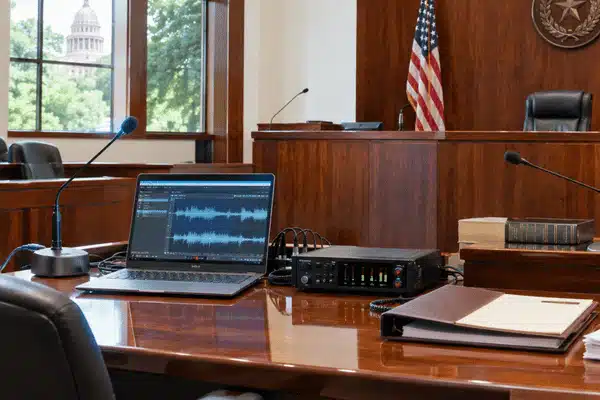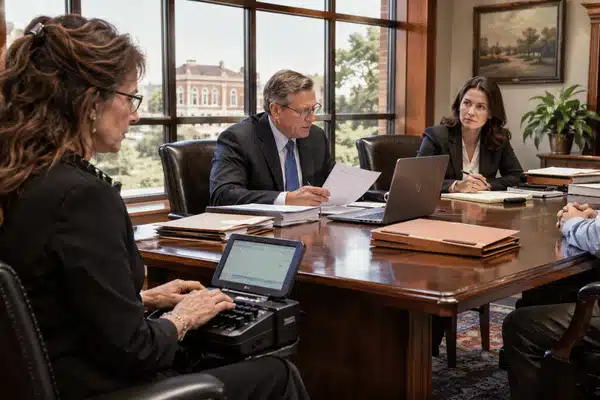

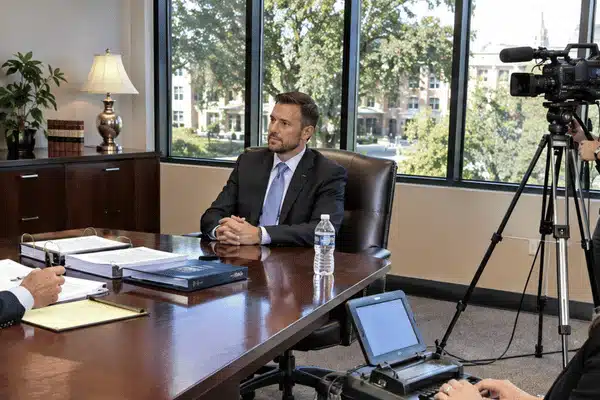
Got a trial coming up in Marshall? If you’re planning a video deposition in Marshall, TX, check your court deadlines before picking a date. You’ll need to notify the other parties and arrange for someone to record the testimony. It’s also worth deciding early whether everyone will attend in person or join remotely.
Those deadlines depend on which court is hearing your case. Marshall is the county seat of Harrison County, so state cases are heard at the Harrison County Courthouse. Federal cases go to the Sam B. Hall Jr. Federal Building and United States Courthouse, where the Eastern District of Texas holds court for its Marshall Division. That federal court handles one of the busiest patent dockets in the country. According to legal analytics firm Lex Machina, the Eastern District of Texas received 2,941 patent cases from 2023 through 2025, or 25.7% of all patent lawsuits filed in the U.S. during that period.
In Texas state court, serve the witness and all parties with notice of the video recording at least five days before the deposition. Skip weekends and legal holidays when counting those five days. In federal court, the deposition notice must say how the testimony will be recorded. If you plan to take the deposition remotely, Texas allows it with reasonable advance written notice. In federal court, the parties must agree or the court must order it.
A video deposition is sworn testimony recorded on camera. Attorneys ask the witness questions while a videographer captures the session.
Unlike a written transcript, video shows how someone responds. You can see their expressions, hear their tone, and notice pauses.
This can be useful in personal injury claims, business disputes, and patent cases. Attorneys may also use portions of the recording at trial when the rules allow it.
Both Texas and federal rules recognize video as a way to record a deposition. Texas Rule 199.1(c) lets any party record a deposition by means other than stenography, including video. Federal Rule 30(b)(3)(A) allows audio, audiovisual, or stenographic recording unless the court orders otherwise.
A transcript tells you what someone said. Video lets you see and hear how they said it.
That extra detail can help when reviewing important testimony or preparing for trial.
There are other reasons attorneys choose video:
Video can also carry extra weight in a federal jury trial. Under Rule 32(c), if any party asks, deposition testimony offered for a purpose other than impeachment must be presented in nontranscript form, such as video, when it’s available, unless the court orders otherwise for good cause.
At Central Texas Litigation Support Services, our legal video services include witness recordings, remote depositions, and video synced with transcripts.
There are a few things to arrange before the witness takes the stand. Here’s where to start.
Look at the scheduling order before choosing a date. Some courts require depositions to finish well before trial.
Don’t leave the recording until the last minute. You’ll need time to get the files back and go through the testimony.
In Texas state court, the discovery period depends on the case’s discovery level under Rule 190. Level 2 applies unless the case falls under Level 1 or the court orders a Level 3 plan. For Level 2 cases outside the Family Code, discovery ends at the earlier of 30 days before trial or nine months after the first initial disclosures are due. Under Rule 199.2(a), a deposition taken outside the discovery period needs the parties’ agreement or leave of court.
In federal court, the scheduling order sets the discovery deadline. Unless the parties agree, Rule 30(a)(2)(A)(i) also requires leave of court before the plaintiffs, the defendants, or the third-party defendants take more than 10 depositions.
Include the witness’s name, when and where the deposition will take place, and how you’ll record it.
Under Texas Rule 199.1 (c), parties must receive at least five days’ notice of a video recording. Rule 199.2 also requires reasonable notice of the deposition itself.
Federal Rule 30(b)(3) requires the recording method to appear in the notice. The party who notices the deposition bears the recording costs. Any other party may add a second recording method with prior notice, at its own expense unless the court orders otherwise.
When looking for a legal videographer in Marshall, Texas, ask about experience with depositions.
Confirm who will handle the cameras, microphones, and final files. For an oral deposition taken in Texas under state court rules, arrange for a certified shorthand reporter unless a statutory exception applies.
Before questioning begins, an officer with legal authority must place the witness under oath.
Put your exhibits in order so you aren’t searching for documents halfway through questioning. For online sessions, decide who will display each file and how the witness will view it.
If you’re taking the deposition remotely, check the sound with the witness before starting. A weak connection or faulty microphone could mean having to repeat questions or answers.
Ask the recording team what they’ll send you after the session. It’s worth getting a delivery date in writing, especially when trial is close.
Will you get the full recording, a transcript, or both? If you need clips for trial, mention that early so the provider knows what to prepare.
Review the scheduling order and discovery cutoff before choosing a date.
Include the date, location and recording method. Texas state courts require at least 5 days’ video notice.
Arrange a legal videographer and confirm court reporting and oath requirements.
Organise exhibits and test audio, video and screen sharing before the session.
Agree on video, transcripts, trial clips and delivery dates.
Marshall has both state courts and a federal courthouse. The rules depend on where your case is filed.
| Requirement | Texas State Court | Federal Court |
| Video notice | At least 5 days | Reasonable written notice |
| Recording rules | Rule 199.1© | Rule 30(b)(3) |
| Remote depositions | Rule 199.1(b) | Rule 30(b)(4) |
| Trial use | Rule 203.6 | Rule 32 |
Recording a deposition correctly doesn’t mean the footage will always be allowed at trial.
Courts still consider evidence rules, objections, and case orders. Attorneys handling federal cases should also review the Eastern District of Texas Local Rule CV-30.
Local Rule CV-30 limits objections to questions to “Objection, leading” and “Objection, form,” and objections to answers to “Objection, nonresponsive.” These objections are waived if they aren’t stated in that form during the deposition. The rule also bars instructing a witness not to answer unless Federal Rule 30(c)(2) permits it. Texas Rule 199.5(e) uses the same three short-form objections in state court.
Not everyone involved in a case can travel to the same room. Remote depositions give attorneys and witnesses another way to attend.
Texas Rule 199.1(b) allows remote depositions with reasonable prior written notice. Federal Rule 30(b)(4) allows them by agreement or court order.
For a remote session, you’ll want to sort out a few details:
Some attorneys now prefer video files linked to searchable transcripts. It makes finding a particular answer easier when reviewing the case. AI-generated drafts are another option, though every transcript still needs checking for errors.
The American Bar Association’s Formal Opinion 512 also addresses client confidentiality when attorneys use AI.

A video deposition for out-of-town counsel can take more planning, especially when several attorneys need to attend.
Coming in from Dallas, Houston, or farther away? A few small checks can save you an extra trip or a missed start time.
For legal video services in the Eastern District of Texas, confirm local arrangements before the deposition date.
Texas Rule 199.1© requires at least five days’ notice of video recording. The deposition itself also requires reasonable advance notice. Federal Rule 30 requires reasonable written notice but sets no fixed minimum.
Yes, although you can’t assume every recording will be accepted. Federal Rule 32 permits certain uses, such as challenging a witness’s testimony or presenting testimony when a witness is unavailable. Texas Rule 203.6 also covers how video recordings may be used in court.
Texas generally requires a certified shorthand reporter for oral depositions taken in the state under state court rules. One exception allows a party, that party’s attorney, or a full-time employee of either to make a video-only recording. The party arranging the recording must still serve the required notice and have someone authorized to administer oaths swear in the witness.
Yes, but check the rules for your case before arranging it. Texas allows remote depositions with reasonable prior written notice. In federal court, Rule 30(b)(4) requires the parties to agree or the court to order the remote deposition.
The videographer makes sure everything is caught on camera, from the witness’s answers to what happens during questioning. They’ll check the sound and picture before anyone starts. If the attorneys need to go off the record, they’ll stop filming and pick up again when questioning resumes. After the session, they’ll get the video ready for the legal team.
That depends on the length of the deposition and the files requested. Editing clips or syncing video with a transcript can take extra time. Ask about delivery dates and rush options when making your booking.
Nobody wants to discover a missing file or a recording problem just days before trial. For your video deposition in Marshall, TX, check the notice requirements and agree on the recording details ahead of time. If you need help with the video, contact Central Texas Litigation Support Services to discuss your case and preferred date. Get a quote today and ask about availability.