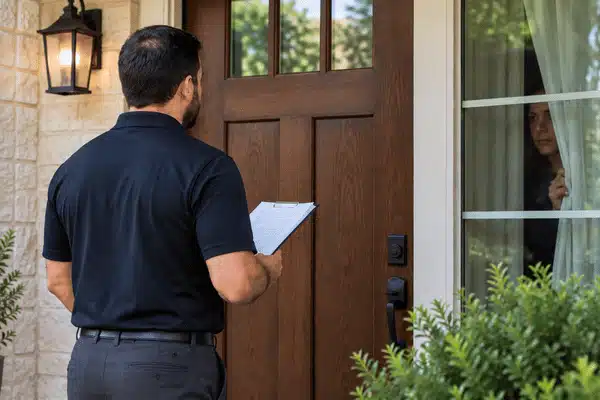


A defendant has moved, the address on file is outdated, and the process server keeps coming back empty-handed. What happens next? Skip tracing services can help track down a current address or another place to attempt service. If those attempts fail, Texas law gives attorneys other ways to move the case forward.
Those options come with strict paperwork. When a defendant never answers, Texas courts do not presume that service was done correctly, and a default judgment resting on flawed service can be vacated. Finding the defendant is only half the job. The other half is building a service record that holds up.
At Central Texas Litigation, we help law firms in Waco and Central Texas locate defendants and complete process service.
An address listed in a court filing may no longer be accurate by the time someone tries to serve legal papers there. Skip tracing services help investigators look for more recent information. They may check property ownership records, past court cases, business filings, or publicly available online profiles to find clues about where the person currently lives or works.
It’s also worth knowing the difference between these three services:
Not every record is open to investigators. The Driver’s Privacy Protection Act restricts DMV information, though 18 U.S.C. § 2721(b)(4) allows certain uses in legal cases, including service of process. Texas has a parallel law, the Motor Vehicle Records Disclosure Act. Section 730.007 of the Texas Transportation Code also lists use in court proceedings, including service of process, among the permitted reasons for disclosure.
Before hiring someone to locate a defendant, attorneys should also check who will be conducting the investigation. Texas Occupations Code § 1702.104 classifies a business paid to obtain or provide information about someone’s whereabouts as an investigations company. Under § 1702.101, this type of work generally requires a license unless an exemption applies. Centex handles skip tracing through its private investigation division, Spectrum Intelligence Group (A07627).
Some defendants refuse to answer the door or make themselves difficult to find. But evading service of process doesn’t make a lawsuit disappear.
Under Texas Rule of Civil Procedure 106(a), papers can generally be served in person or by registered or certified mail with a return receipt requested.
If those methods fail, the attorney can ask the court to approve substituted service under Rule 106(b).
The request must include a notarized statement or declaration made under penalty of perjury. It must identify where the defendant can probably be found and describe the failed attempts. The rule asks for specific facts showing that service was attempted at the same location named in the statement.
Depending on the evidence, a judge may allow papers to be left with someone older than 16 at that location. Other methods may also be approved.
Does Texas require three service attempts? Not under Rule 106. There is no fixed statewide minimum, although local requirements may apply.
A defendant who avoids the process server doesn’t make the legal requirements any easier for the plaintiff. If the case ends in a no-answer default judgment, the court record must show that the service rules were followed precisely. The Supreme Court of Texas has made clear that courts cannot simply assume the citation was properly issued, served, or returned. There’s also a waiting period under Rule 107(h). Proof of service must be on file with the clerk for 10 days before a default judgment can be granted, excluding the filing date and the day judgment is entered.
Finding a new address is useful, but someone still needs to confirm whether the defendant can be served there.
A typical case follows these steps:
That last step can make a difference in court.
Match records to the correct defendant.
Compare recent records with client details.
Target locations where the defendant is likely to be found.
Record dates, times, addresses, and outcomes for Rule 106(b).
Share findings for further attempts or court motions.
Carry out approved substituted service exactly as ordered.
In Spanton v. Bellah (2020), the Supreme Court of Texas overturned a default judgment because the service return listed an address that did not match the court’s order.
The order authorized substituted service at a house number on “Heathers Hill Drive,” but the return said the papers were served at that number on “Heathers Hills Drive.” Nothing in the record showed the two were on the same street, so the Court vacated the $950,000 default judgment. As the Court explained, when a judge orders substituted service under Rule 106, the order itself is the only authority for that service.
Delays in serving a defendant can create another problem when the statute of limitations is involved. In Proulx v. Wells (2007), the Supreme Court of Texas explained why filing a lawsuit before the deadline isn’t always enough. The plaintiff must also make a diligent effort to get the defendant served. If service happens after the limitations period expires, it can relate back to the original filing date, but only when the plaintiff shows diligence and accounts for gaps in the effort. Federal cases follow a different timeline. Under Rule 4(m), plaintiffs generally have 90 days after filing a complaint to complete service. Courts must extend that period when the plaintiff can show good cause.
Our Texas process service team helps attorneys handle difficult service cases and keep track of attempts.
Yes, although finding someone’s email address or Facebook profile does not mean papers can be sent there right away.
Rule 106(b)(2) allows a Texas court to approve electronic service when the evidence shows it is reasonably effective to give the defendant notice of the suit.
This option has been available since December 31, 2020, when an amendment to Rule 106 took effect. The Supreme Court of Texas made the change in response to Civil Practice and Remedies Code § 17.033, which called for rules allowing substituted service through social media.
Before approving that method, judges should consider two questions:
Attorneys must still meet Rule 106(b)’s requirements for documenting failed service attempts.
The next move depends on why the service failed. Someone who moved without leaving a new address presents a different problem from a company with no reachable registered agent.
The circumstances of each case help determine which rule an attorney should review. For example, a defendant who still lives at a known address but won’t answer the door may require a different approach from someone whose location remains unknown after several searches.
| Situation | Rule or Option to Review |
| Home or work address is known | Rule 106(a) |
| Failed visits at a likely address | Rule 106(b) |
| Verified email or social account, plus failed attempts | Rule 106(b)(2) |
| Defendant’s location remains unknown after a thorough search | Rules 109 and 109a |
| Company’s registered agent cannot be found | Business Organizations Code § 5.251 |
| Certain defendants living outside Texas | Civil Practice and Remedies Code §§ 17.044–17.045 |
| Case filed in federal court | Federal Rule of Civil Procedure 4 |
An unsuccessful visit to an outdated address usually isn’t enough to support service by publication. Rule 109 requires a diligent search for the defendant. The court must also review the efforts made to locate that person before entering judgment.
Publication has its own requirements, so it isn’t something attorneys can arrange overnight. Under Rule 116, the citation generally needs to appear in a newspaper once a week for four consecutive weeks. The first notice must be published at least 28 days before the return is filed. The citation must also remain on the state’s Public Information Internet Website for at least 28 days before that filing. There is another possibility under Rule 109a. Once publication is authorized, the judge may approve a different method that is just as likely to notify the defendant. And if someone served through publication never answers, Rule 244 requires the court to appoint an attorney to defend the case.

The private process server cost depends on the work involved. Serving someone nearby at a confirmed address is usually less involved than locating a person who has moved several times.
Several things can affect the quote:
Before booking, ask what’s covered by the fee. An address check may save a trip to a home the defendant left months ago.
Skip tracing involves looking beyond the address someone last provided. An investigator might compare property records, business information, and other available sources to see whether the person has moved or taken a job somewhere else. The information can point a process server toward another place to try. However, finding a possible address doesn’t mean the legal papers have been served.
Refusing to open the door might delay personal service, but it won’t necessarily stop the lawsuit. Texas courts can approve another service method when Rule 106(b)’s requirements are met. A defendant who is properly served and fails to respond may face a default judgment.
Rule 106 does not require a set number of attempts across the state. Attorneys must provide detailed records of failed attempts at a location where the defendant can probably be found. They should also check the requirements of the court handling the case.
Email service can be valid when a court approves it under Rule 106(b)(2). The attorney must show that the method is reasonably likely to reach the defendant and meet the rule’s other requirements. Sending papers to an email address without the needed approval does not satisfy this rule.
Not just anyone can serve court papers in Texas. Rule 103 allows sheriffs, constables, JBCC-certified process servers, and others with legal or court approval to do the job. The server cannot be a party or have an interest in the case, and certain papers have extra restrictions.
Texas Business Organizations Code § 5.251 may allow service through the Secretary of State. For qualifying entities, this can apply when an agent cannot be found at the registered office despite reasonable diligence. It can also apply when the entity fails to maintain a registered agent.
No. Finding someone’s current address only gives the process server somewhere to try. The papers must still be delivered according to the applicable rule, law, or court order. Proper records are also needed to show how the service was completed.
If the address on file leads nowhere, another visit to the same door may not help. Finding a better lead and keeping clear records of failed attempts gives attorneys more to work with. Central Texas Litigation helps law firms across Waco and Central Texas locate and serve hard-to-reach defendants. Need help with a difficult service case? Get a quote and tell us what you’ve tried so far.